DOORKEEPER
A Chronicle of the Unseen War
Doorkeeper
In an unseen war, someone has to hold the door
He was made after the host of heaven was counted: no rank, no choir, no kind.
The brightest of the sons of God was his only friend, until the day that friend asked him to choose. A novel by Owen Eskew.
open now
Eden. The Flood. Jericho. Jerusalem under siege. Bethlehem.
You know the stories. You’ve never seen the war behind them.
I was made last. No rank, no wings, no choir, and nobody told me why. God gave me a door to keep, and the brightest of the sons of God for a friend. Then one morning my friend came up the mountain with a third of heaven behind him and asked me to step aside.
I shut the door.
Now my “friend” hunts the One promised in the garden, a child who would be his demise. Every door on that child’s road, I have to hold. And above every battle you know, the host of heaven goes to war against the prince of the power of the air and all his armies.
I don’t know what’s coming.
Neither does my friend.
Pull up a step. I’ll show you what I’ve learned about doors and an unseen war.
Tzir
The war behind the stories
“I was his friend before I was his enemy.”
One was the brightest thing ever made. The other was not in the count at all. Choose a side of the door.
Tzir
tseer · a hinge, an envoy, the pain before a birth
Select to readMade on God’s own doorstep after the host of heaven was counted. Bronze gone dark, with a thin seam of gold light at every joint. No wings, no armor, no sword. He carries one thing: the hinge pin of the first door he ever shut.
He is worth nothing in a meadow. Give him a threshold and he does not move.
“I was made for the narrow place. Give me a gate, a pass, a gap between two stones, and I am worth a legion.”
Helel ben Shachar
hay-LAIL ben SHAH-khar · Shining One, son of the dawn
Select to readThe anointed guardian who stands nearest the throne, in a robe sewn with nine kinds of stones. He is the only one in heaven who ever sat down beside a wingless thing in a doorway. He gave Tzir his name.
After the fall he becomes the Accuser. In the court of heaven he wears a scribe’s plain linen, with ink on his fingers and a reed behind his ear. Everywhere else he wears whatever will make the rest of the room look small. He never lays a hand on anyone. He only asks a question.
“The trouble is that he so rarely needs to lie to me. He only chooses which true things to say.”
Michael
Great prince of the host. His name is his war cry: Who is like God?
Abdiel
Captain of a legion of six thousand, built like a siege tower, and the one who can’t forgive himself. His first words about Tzir: “What is it for?”
Hazakiel
His name means “God strengthens.” He can’t fight. He keeps the fighters standing.
The princes
Behind every throne in the ancient world stood another throne that no one could see. Asshur. Bel of Babylon. The Ram of Persia. The Goat of Greece.
Twenty-eight thresholds. One promise.
Orders reach Tzir a few words at a time, up through whatever sill he is standing on. Nobody tells him why this door or that one. Eight doors stand open here. The rest stay shut until you read them.
“I had thought I was sent to places. I am starting to think that I am sent to people, and that the doors are only where the people happen to be standing.”
“Let no one tell you that the choice is easy. Light on one side, dark on the other, choose. That is a story for children.”
Prologue“A lie repeated wears a groove. A truth heard once has to be taken out and looked at on purpose, or it is lost.”
The Seventh from Adam“He hunts for what is strong. He has never learned where He hides things.”
Under His Wings“Assyria isn’t a kingdom the way Judah is a kingdom. It is a machine for eating kingdoms.”
The Runner“Obedience and peace are different things, and for a very long time I have only the first.”
The Prosecutor“When He is silent, the last thing He said still stands.”
Keep the DoorThe Bible is a deeper book than most of us were taught.
To its first hearers the world had two layers, the seen and the unseen, and whatever happened in one shaped the other. This novel takes them at their word.
Two households
Scripture gives God a family in heaven and a family on earth. The first was singing on the day the earth’s foundations were laid.
Job 38:4-7 · Psalm 82:1 · Genesis 1:26-27Three rebellions
The family is torn in three stages: in the garden, before the Flood, and at Babel.
Genesis 3 · Genesis 6:1-4 · Genesis 11:1-9Seventy princes
At Babel the nations were handed to members of the heavenly household, who did not rule justly. An angel once told Daniel he was three weeks late because the prince of Persia had blocked the road.
Deuteronomy 32:8-9 · Daniel 10:13The way home
Right after Babel, God calls one man. The promise narrows to one tribe, then one royal house, and then one child.
Genesis 12:1-3 · 2 Samuel 7:16The unseen war is not a contest between two equal powers. It is a fight over a family, and the Father has already won it.
What is invented, and what is not
- Every word spoken by God, the man, the woman, and the serpent in Eden is taken from Genesis 2 and 3.
- The siege of Jerusalem, the letter Hezekiah spread before the Lord, and the 185,000 (2 Kings 18-19; Isaiah 36-37).
- The stones of fire and the mountain of God (Ezekiel 28).
- “Helel ben Shachar” is the Hebrew behind “Lucifer” in Isaiah 14:12.
- Tzir himself: the one being made after the host was counted.
- The pin, and his gift of shutting.
- The captain Abdiel, Hazakiel, and the Bull of Asshur.
- Every conversation with the Accuser.
- The war scenes, among them the war on Hermon and the powers of Canaan at the fall of Jericho.
- The Watchers’ names and their oath on Hermon come from 1 Enoch.
- Sennacherib’s own annals claim forty-six towns of Judah.
- The pass called the Persian Gates, and the shepherd’s path around it, are history.
- The One who walks out of the gate is never described beyond a hem and a sandal.
- Tzir never wins a fight that belongs to God.
The book’s appendix gives the Scripture under each scene. For the worldview itself, start with Michael S. Heiser, The Unseen Realm.
How to say them, and what they mean
“The first thing I ever see is my own hands.”Prologue · Before the Count
Doorkeeper
A Chronicle of the Unseen War · Owen Eskew
- InsidePrologue, 27 chapters in five parts, appendix
- ISBN979-8-9965615-4-4
- ReleaseTo be announced
- PublisherONSQ Enterprise Press
Doorkeeper releases first on Amazon. You do not need to know the Bible to follow it. Everything you need is in the story.
Chronicles of the Unseen War
The events you may already know, shown from the other side.
Doorkeeper
The stories you know, and the war that was fought behind them. It starts on a bronze sill, before the world.
Pre-orderThe Door Is Open
Tzir spends this whole book keeping doors. But there is one door that no enemy can shut and no doorkeeper has to guard, because the Door is a Person, and He is standing open for you.
“I am the door. If anyone enters in by me, he will be saved, and will go in and go out, and will find pasture.”John 10:9 (WEB)Write to Owen
Prologue
Before the Count
Your heart grew proud of your beauty; you corrupted your wisdom because of your splendor; so I cast you to the earth; I made you a spectacle before kings.Ezekiel 28:17
The first thing I ever see is my own hands.
They are lying open on my knees. They are the color of bronze that has gone dark with age, though nothing here has had time to age. At every knuckle there is a thin seam of gold light, as if I had been made in pieces and fitted together and the fitting showed. I turn them over. I have never seen hands before. I don’t know yet that they are plain. You’d have seen it at a glance.
I am sitting on metal.
It is a single slab of bronze, twelve paces long and thicker than a man is tall, set into the mountain like the sill of a house. It is warm under me. It hums, very faintly, the way a bell goes on humming after you can no longer hear it.
I will learn later what a sill is for. It is the lowest stone in a house, and it carries the whole weight of the door. Everyone who goes in or out has to cross it, and almost no one looks down. It is the first thing I ever stood on. It is how I will hear Him for the rest of my life.
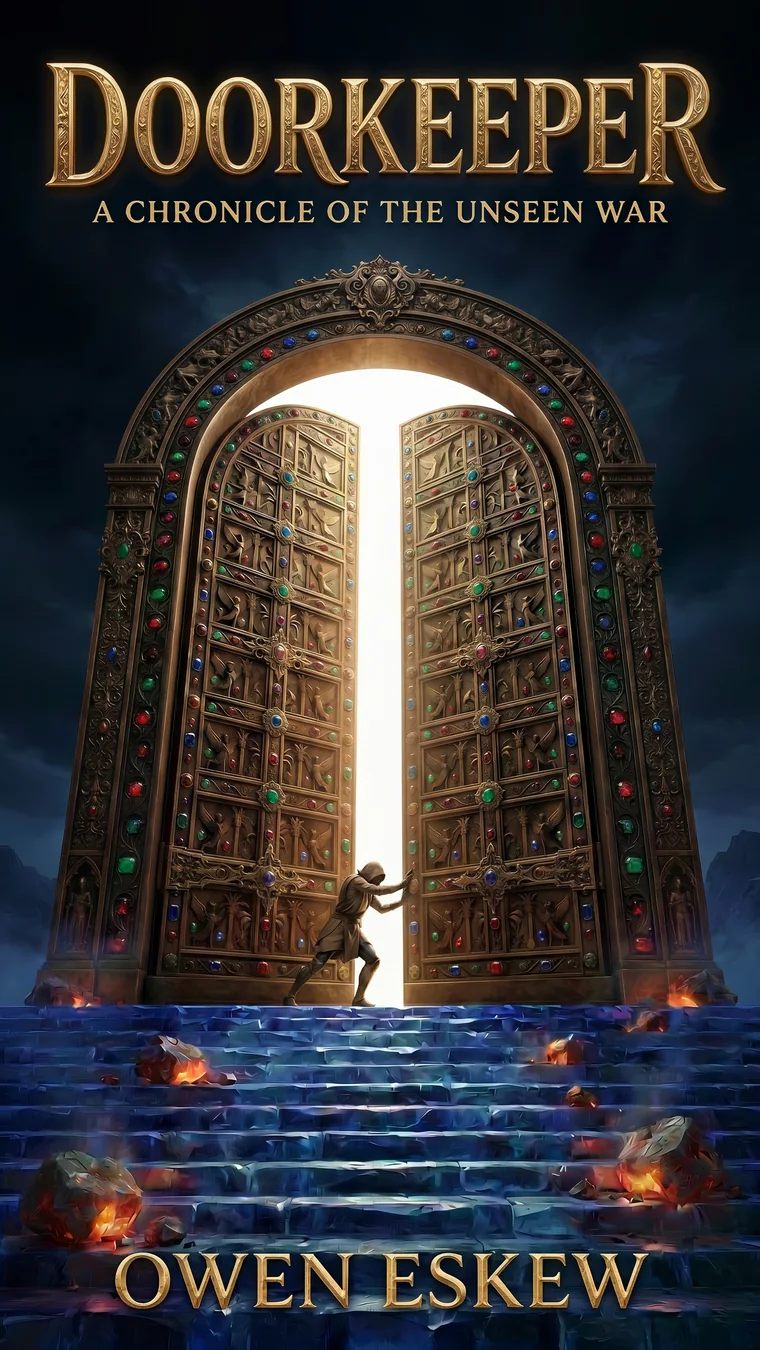
On either side of me stand the doors.
I have to tip my head back to see them. Then I tip it farther, and I still can’t find the top. They are two leaves of bronze the color of dark honey, each one cast in a single pour, taller than any cedar that will ever grow. They are worked from sill to lintel in rows: cherubim with their four faces, then palm trees, then open flowers, then cherubim again. There are ten thousand figures, and no two are alike. When I look straight at them they are still. When I look away, I am almost sure that they move.
Each leaf turns on a pin. I can see the nearer one from where I sit, a shaft of bronze as thick as my arm, standing in a socket of white stone. That is all that holds a door the weight of a mountain.
The doors stand open. I learn later that they have never been shut. Nothing has ever needed to be kept out.
The gap between them is wide enough for a legion to march through, and I am sitting in the middle of it. Light pours through from behind me, white with gold in it. It runs across the bronze and over my knees and on down the mountain. It is warmer than the metal. Something drifts out with it, thin as breath: a smoke that smells of rain, and of the air just before lightning.
I don’t turn around. I don’t know why. I only know that I am not ready to.
Behind me, someone is singing.
It is many voices. It comes down the light like the sound of the sea, voices calling to one another across some vast space, one word, three times, over and over. Each time it comes, the white stone of the doorposts shivers. The sill shivers, and I shiver with it.
Then, over the singing, comes a Voice.
It isn’t loud. It doesn’t need to be. It goes through me like a pin through a hinge, and it is one word long.
Mine.
That is all I get. It tells me whose I am. It tells me nothing about what.
I look outward, because the Voice has left me shaking.
The mountain falls away below the sill in terraces, and the terraces are paved with sapphire. I don’t mean blue stone. I mean sapphire, as clear as the sky on its best day, so that I can look down through the pavement into deeper and deeper blue. Stones of fire lie scattered across it like coals across a hearth. Each is the size of a bull, and each burns without smoke. A river comes out from somewhere under the sill and runs down through the terraces, bright as glass. Trees stand along its banks, and their leaves chime when the light moves through them.
There is no sun. Everything here gives light: the stones, the river, the pavement itself. Nothing casts a shadow.
It takes me a long time to learn where that light comes from. None of it belongs to the things that give it. It all comes from the throne. The stones and the river and the host have stood so long in His presence that His glory has soaked into them, and it shines back out of them the way heat comes back off the stones of a hearth. Ages from now I will watch a shepherd come down from a mountain in the desert after forty days with God. His face will shine so brightly that his own brother is afraid to come near him, and he will have to put a veil over it. I will think of this mountain. That is what the host are. Every one of them is that shepherd coming down the mountain. And like his, the shine fades on anyone who walks away from where it came from.
I look behind me. A long thin darkness lies across the bronze.
It is mine. It is the only one on the mountain.
The terraces are full.
The host of heaven has been made the way stars are made, in fields. On the first terrace a legion is drilling, six thousand of them, in ranks so straight that I could lay a rule along them. Their armor glows like iron fresh from the fire. At each pair of shoulders stands a brightness that my eye insists on calling wings. They wheel as one body. Their captain calls a word, and six thousand blades come up together and catch the light.
Higher up, where the air itself begins to burn, the seraphim hang in rings. They are too bright to look at for long, six sweeps of glory to each. Lower down, the cherubim keep the roads. They are vast and patient, each with the face of a lion, an ox, an eagle, and a man, and beside them turn wheels within wheels, with rims full of eyes. Choirs stand in tiers along the river. Heralds cross between them with scrolls under their arms and somewhere to be.
Every one of them has a place. I can see it from here. Each has a rank on his shoulder, a brother on his left, and a brother on his right. When they sing, the song has a part for every one of them and none left over.
I know all of this within a breath of waking, the way you know which way is up. I know one thing more.
They were counted before I was made. The count is closed, and I am not in it.
I am one. I have no legion and no choir. I have none of the glory that the host wear at their shoulders. I am dressed in a plain wrap the exact color of the sill, as if I had been cut out of it and nobody had finished the job.
They don’t know what to do with me.
The seraphim watch from a distance, the way fire watches. A cherub turns all four faces my way and finds nothing to salute. The captain of the drilling legion climbs the steps to take a look. He is broad and close-cropped, built like a siege tower, in plates that glow a dull red, and he keeps one hand on his sword hilt. His name is Abdiel. He walks a slow circle around me with his jaw set.
“What is it for?” he says. He doesn’t say it to me. He says it to the air.
I have no answer. He grunts and goes back down to his ranks, like a soldier who has found an unmarked crate in his armory.
So I stay in the doorway. There is nowhere else that is mine. I learn the grain of the bronze. I learn the figures on the doors, row by row. I learn that when I rest my back against the left leaf, it shifts. The whole unthinkable weight of it moves a finger’s width and settles again, the way a horse leans into a hand it knows. It doesn’t do that for the seraphim. I have watched. It does it only for me.
I am too new to wonder why.
Abdiel’s question outlasts his visit. What is it for? I carry it a very long time.
A long way from the mountain. Millennia removed. On earth, at night, in a nowhere village.
I have kept many a door, gate, and threshold since the mountain. Bronze taller than cedars. Iron. Gold. None was more precious than this one.
It is made of sticks and twine and clay mortar.
It is a hurdle of woven branches, propped across a hole in a hillside and packed at the edges with clay. There is a gap under it wide enough for a cat.
I would like it noted that I have not complained.
It is cold. Frost is forming on the stones. In front of me, the ridges are full. Everything that has ever wanted me out of a doorway has come to this one, on the same night, and they don’t even like each other. They crouch along every skyline. Some are tall and crowned. Some are low and have too many legs. Some are only a darkness with eyes in it. None of them can be seen by the shepherds keeping watch on the next hill, and all of them want the same thing: to get in, and to break whatever is inside. The host of heaven is somewhere overhead. Not one of them has been sent down.
I have checked.
The word for tonight came up through the dirt an hour ago. It was three words long.
Keep the door.
So it is me, and the sticks.
The powers on the ridges come down the slope all at once, without a sound, and hit the door together. I say one word to it. Shut. A few branches tied with twine can’t be shut. They hold anyway. Not the sticks anyone could see. Those sit as crooked as ever. The other door, the one behind them, holds. I put my back to the rock and work. It is ugly and close and fast. There is no room in a doorway for anything else.
Then they draw back and sit down in the frost to wait.
Someone is coming down the track. He is alone, and in no hurry at all. I would know that walk anywhere.
He stops an arm’s length from my sticks. He looks at them. He looks at me. He smiles.
“Little hinge,” he says. “Of all the doors.”
“It surprised me too.”
“Step aside.” He says it gently. He is always gentle with me. “I have asked you so many times. This is the last.”
He has. That much is true.
I was his friend before I was his enemy.
Remember that when you hear what I have done to him. Remember it when you hear the names he gives me. He is allowed to hate me. He earned the right on the day I shut a door on his hand.
The prologue continues in the book.
Pre-order Doorkeeper